A mouse mover for Mac changes the pointer’s position automatically. Mouse Jiggler does this from a menu-bar panel with movement timing and optional scheduling. For a basic session, use Natural mode with Clicks and Scroll set to None, then wait through the configured idle delay.
Three actions with different consequences
Searching for a mouse mover can lead to tools that also click or scroll. These capabilities should be evaluated separately. Moving the pointer can affect hover states; clicking can press a button; scrolling can move a reference away from the place you were reading.
Keeping a Mac awake does not automatically require all three actions. Choose the smallest set of behaviors that serves the task. This guide describes controls visible in the Mouse Jiggler 3.1 interface; exact options may differ in the version you install.
See the movement controls
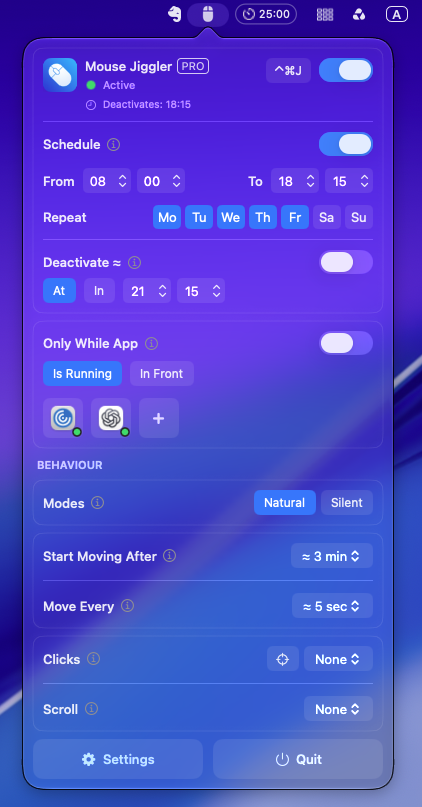
Explore Mouse Jiggler for Mac for the feature overview, or follow the installation steps. You do not need to enable automatic clicking just to test cursor movement.
Start with movement only
In the menu-bar panel, review Modes, Start Moving After, and Move Every. The first timing control sets the idle delay before movement starts; the second sets how often it repeats. They are not interchangeable.
For a visible setup check, use Natural mode and leave Clicks and Scroll set to None. Wait through the configured idle delay without using the keyboard, mouse, or trackpad. Choose a delay shorter than the Mac’s idle sleep timeout for this test.
Do not infer Silent mode’s exact behavior from its name. Observe the version you are using before relying on it during a specific workflow.
Add clicks only for a deliberate action
An automatic click can act on whatever receives that input. Before enabling it, consider which window is in front, where controls are located, and what happens if the window changes.
Use a harmless test document or a non-destructive part of your workflow to understand an available option. Avoid treating a successful click in one layout as proof that the same action is safe after resizing or switching windows. Leave click automation off for ordinary reading or a presentation unless it is intentional.
Treat scrolling as a separate reading choice
Scrolling changes the view inside a page or app. If your purpose is to keep a reference visible, unattended scrolling may work against that purpose.
When evaluating a scroll setting, check the direction, the visible result, and what happens when you switch to a different window. If you only want the display to remain on, compare the three keep-awake methods before enabling more input actions.
Keep an easy stopping point
Choose a short session with a clear end. Know where the app’s main switch is and review the Deactivate controls. Add scheduling and app conditions only after basic movement behaves as expected.
The short-session settings guide provides a practical order for configuring those controls. If input does not work at all, check macOS permission before adding clicks or reducing every timer.
Example: keep a reference in place
Open a harmless reference document and start a movement-only session. Leave scrolling off so the text stays where you put it, and leave clicking off so a passing pointer cannot activate a control. After the idle delay, observe the movement and use the main switch to stop.
Before using this during a presentation, rehearse with the same display arrangement. If you only need the screen to stay lit and do not want pointer movement, use a timed display-awake command instead.
Make your next session simpler.
Explore Mouse Jiggler’s menu-bar movement, timing, and scheduling controls.
Download for Mac