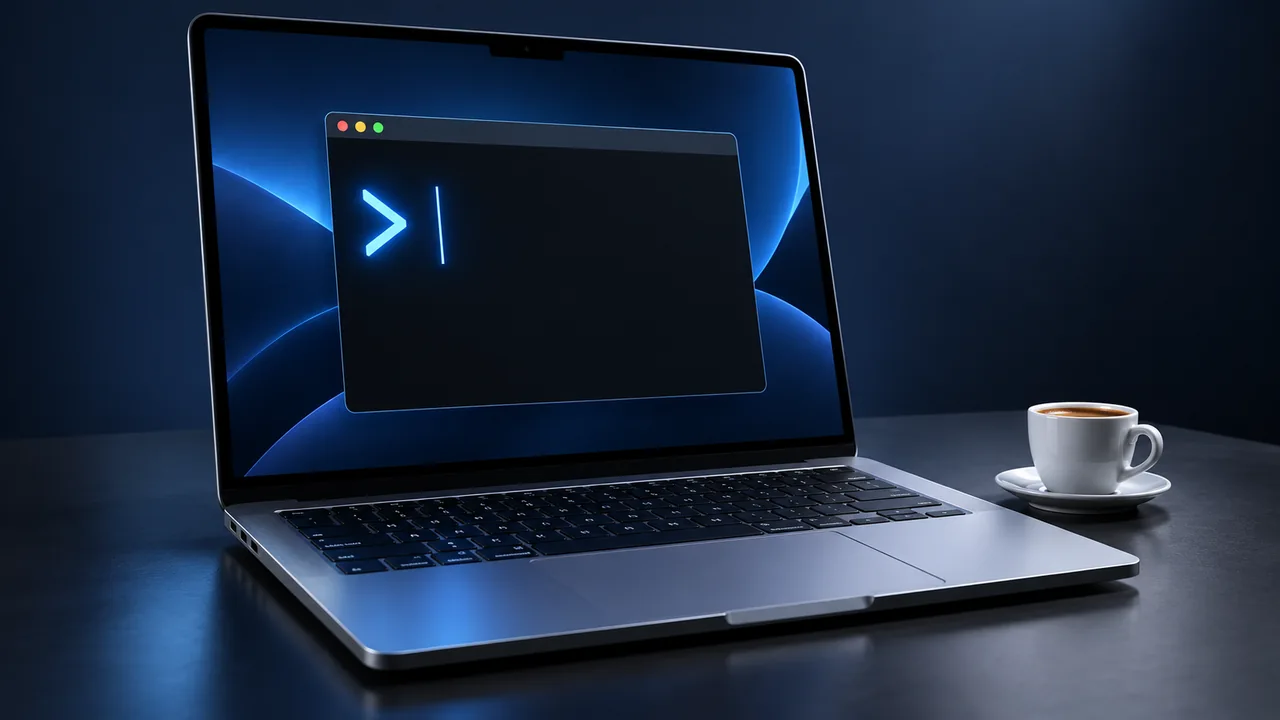
Open Terminal and run caffeinate -i -t 3600 to prevent idle system sleep for one hour. Add -d if you also need the display to stay on. Press Control-C to stop early.
What caffeinate actually does
caffeinate is a command included with macOS. It asks the operating system to prevent particular types of sleep while it runs. It does not move the pointer, click buttons, or change a chat app’s presence rules.
Think about what your task needs before choosing an option. A download may need the computer to remain awake while the display turns off. Reading a reference document or watching a dashboard may also require an illuminated screen.
Pick a command for your task
| Task | Command |
|---|---|
| A one-hour download; screen may turn off | caffeinate -i -t 3600 |
| A 30-minute presentation; screen stays on | caffeinate -di -t 1800 |
| A two-hour upload; screen may turn off | caffeinate -i -t 7200 |
| Prevent idle sleep until you stop it | caffeinate -i |
Paste only the command, then press Return. A quiet Terminal window is expected. Keep it open while the session runs. These are temporary requests, not changes to your saved sleep preferences.
Keep your Mac awake for one hour
- Open Terminal, which you can find with Spotlight.
- Enter the following command and press Return.
- Leave that Terminal session running until the task finishes.
caffeinate -i -t 3600The timeout is measured in seconds: 1,800 is half an hour, 3,600 is one hour, and 7,200 is two hours. Terminal normally shows no progress bar. That is expected; a quiet window does not mean the command failed.
To stop before the hour ends, click the Terminal window and press Control-C. Normal sleep behavior can then resume according to your Mac’s settings.
Choose the right flags
| Option | Purpose |
|---|---|
-i | Prevent idle system sleep. |
-d | Prevent display sleep. |
-t 3600 | Release the request after one hour. |
-s | Prevent system sleep while on AC power. |
For a one-hour session with the screen on, combine the options:
caffeinate -di -t 3600Leaving the screen on uses additional energy. For a task that runs without supervision, keeping only the system awake is often the better fit.
What does caffeinate -d do?
-d requests that the display stay awake. -i requests that the system avoid idle sleep. Combine them as -di when you need both. A background download usually does not need an illuminated display; a presentation or reference screen often does.
Running caffeinate with no flags creates an idle-sleep prevention request. Be explicit with -i or -di so the purpose is easy to recognize when you return to the command.
Keep a command awake until it finishes
You can attach the sleep request to a command instead of estimating its duration. For example, in a project that uses make:
caffeinate -i makeThe request lasts while that command runs. This is useful when a build’s completion time varies. The timeout flag is not used when a utility is supplied, so choose either a timed session or a command-scoped session.
When a menu-bar app is more convenient
Terminal works well for occasional, deliberate sessions. A menu-bar app is easier to revisit when you want recurring schedules, cursor movement, or controls tied to a particular app.
Mouse Jiggler offers an idle delay, movement interval, weekday schedules, and deactivation controls. See the scheduling walkthrough for an example. Neither approach should be treated as a promise that closing a MacBook lid will leave a task running.
For the exact options installed on your own Mac, open Terminal and run man caffeinate. Press Q to leave the manual.
How to stop caffeinate
- Return to the Terminal tab where you started the command.
- Press Control-C once.
- Check that the command prompt returns.
A timed command also stops automatically at its timeout. If you have several caffeinate sessions, ending one does not end the others. Stop the specific session you started; there is no need to change system-wide power settings or terminate unrelated processes.
Confirm the request in a second Terminal tab
While the session runs, open another Terminal tab and enter:
pmset -g assertionsLook for the caffeinate process in the process list. A session with -i should have a PreventUserIdleSystemSleep assertion; -di also requests PreventUserIdleDisplaySleep. After stopping your session, its process entry should disappear. Other apps may still have their own requests.
This read-only check helps distinguish a command that is running from a line you typed but never submitted. It does not establish that a remote download completed.
If your Mac still sleeps
Check whether the timeout already ended, the Terminal session closed, or the lid was closed. A timed idle-sleep request is not a guarantee against every sleep cause. If the system stays awake but a transfer stops, continue with the download and upload checks.
For an app that repeatedly reopens sessions, first identify it using Activity Monitor and the power-assertion check.
caffeinate(8) manual. Read it on your Mac with man caffeinate.Make your next session simpler.
Explore Mouse Jiggler’s menu-bar movement, timing, and scheduling controls.
Download for Mac